 التكنولوجيا وأخبارها بوابة مصر لأخبار تكنولوجيا المعلومات والإتصالات وفي أفريقيا كما تعتبر مصدر رئيسي للمعلومات حول تكنولوجيا المعلومات والاتصالات والفرص الاستثمارية المرتبطة بالاقتصاد الرقمي في المنطقة بالكامل



Thirty years represent far more than the passage of time for Cairo ICT, the Cairo International Technology Exhibition for the Middle East and Africa. Since its first edition in 1996, the event has evolved alongside some of the most significant technological transformations shaping the modern world, from mobile phones and the early days of the internet to high-speed communications, digital services, smart cities, artificial intelligence, data centers and cloud computing.
During the 1990s, technology was still a relatively specialized sector operating on the margins of the traditional economy. Yet the vision behind the exhibition was built on an early recognition that telecommunications and information technology would eventually become much more than independent industries. They would develop into essential infrastructure supporting virtually every aspect of modern life, business, production and public services.
This evolution gives the 30th edition of Cairo ICT, scheduled to take place in Cairo from November 7 to 10, 2026, significance beyond the celebration of three decades in the technology industry. It provides an opportunity to assess how Egypt and the wider region have transformed from markets gradually embracing mobile communications and internet services into increasingly competitive digital economies seeking advanced infrastructure, computing capabilities, data resources and artificial intelligence applications.
It also raises a fundamental question: How can the technological progress accumulated over the past three decades be translated into tangible economic, industrial and developmental value, rather than leaving countries dependent primarily on importing technologies and consuming externally developed services?
From Cairo Telecom to Cairo ICT: The Evolution of a Vision
Understanding the exhibition’s history begins with an important distinction: the event did not originally launch under the name Cairo ICT. Its journey began in 1996 under a telecommunications-focused identity, historically referred to as both Cairo Telecom and Cairo Telecomp.
The inaugural edition was presented as the First International Exhibition for Telecommunications, Information Technology, Satellite and Broadcasting. The concept represented an early attempt to bring together industries that many companies at the time viewed as separate and largely unrelated.
However, the exhibition’s founder, media professional Osama Kamal, anticipated that telecommunications, information technology and media would increasingly converge as technological infrastructure developed.
The Egyptian market of the mid-1990s helps explain the significance of that vision. Telecommunications companies were not necessarily convinced that participating in a specialized exhibition would generate meaningful business opportunities, particularly because the number of organizations using their services remained relatively limited compared with the market that would emerge in subsequent years.
At the same time, information technology companies generally regarded telecommunications as a separate field. The concept of an integrated digital ecosystem had not yet become firmly established.
Nevertheless, the timing of the inaugural edition coincided with preparations for the launch of Egypt’s first mobile network in November 1996. This development gave the exhibition an important boost, transforming corporate interest from an experimental participation opportunity into a platform for presenting technologies and services associated with a rapidly emerging market.
The transition to the name Cairo ICT was therefore more than a branding update. It reflected a fundamental change in how the exhibition understood its role.
While the term Telecom primarily refers to the telecommunications industry, ICT encompasses both information technology and communications. This broader definition opened the door to sectors increasingly dependent on digital solutions, including banking, electronic payments, media, manufacturing, transportation and government services.
The new identity reflected a wider philosophy: technology was no longer an isolated industry but a cross-sector driver capable of reshaping economic and social activities.
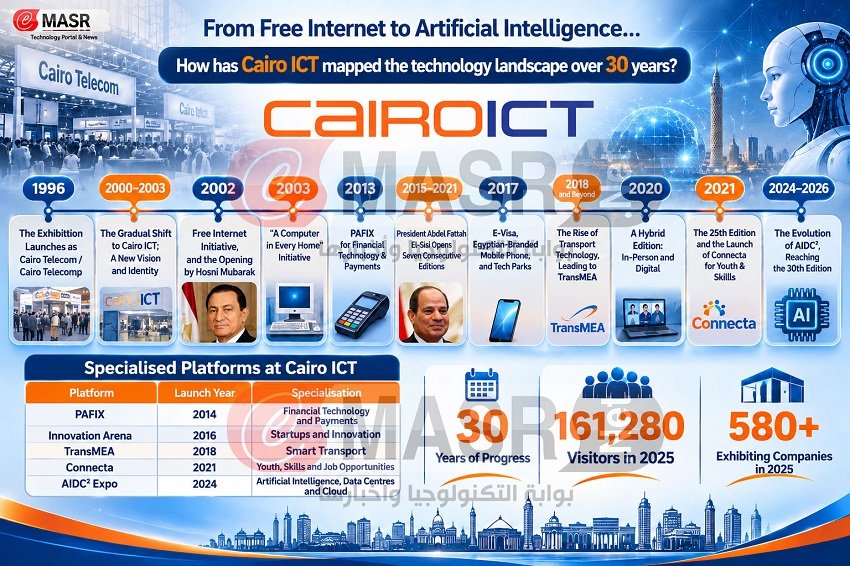
In archival media statements, Osama Kamal explained that the idea of expanding the exhibition’s scope began taking shape in 2000, while the event started assuming its new direction in 2003, when its name changed from Cairo Telecom to Cairo ICT. He also linked the decision to change the name to the visit of former Egyptian President Hosni Mubarak to the exhibition in 2002.
Kamal explained that the underlying vision was to regard information and communications technology as the primary enabler of technologies entering everyday life. Accordingly, the exhibition’s mission should extend beyond displaying telecommunications equipment and services to showcasing applications capable of transforming other industries.
The transition from Cairo Telecom to Cairo ICT thus marked an early declaration of the event’s ambition to move beyond telecommunications and become a comprehensive technology platform.
From Mobile Phones to the Internet: Building a New Market
Cairo ICT emerged at a time when Egypt was experiencing the early stages of a major transformation in its telecommunications sector.
The introduction of GSM mobile services in 1996 was not simply the arrival of another communication method. It marked the beginning of a broader shift in the market and in the relationship between individuals, businesses and service providers.
As mobile phones gradually became more widespread, telecommunications moved beyond fixed-line services and corporate networks to become a mass-market service, creating new opportunities for investment, competition and innovation.
During this period, the exhibition’s role extended well beyond product displays. It provided a meeting point for international and local companies, government institutions and service providers, enabling the industry to monitor technological developments and introduce new solutions to the market.
The first edition coincided with the launch of Egypt’s first mobile network, while subsequent editions became platforms for announcing important initiatives and services. These included the launch of the third mobile network, high-speed internet services, free internet access and the Computers for Every Home initiative.
These milestones demonstrate how the exhibition’s development became closely associated with the expansion of Egypt’s digital infrastructure and the growing number of technology users.
At the time, the main challenge was not simply making devices and networks available, but building a market capable of adopting and benefiting from technology.
Internet expansion, for example, required telecommunications infrastructure, suitable devices, affordable services and greater public awareness of how to use digital tools.
Initiatives designed to expand access to computers and internet services therefore carried particular importance. They shifted the discussion beyond the boundaries of the specialized technology sector toward a broader question: How could access to technology transform education, employment, communication and access to information?
From Telecommunications to the Digital Economy
As the new millennium progressed, traditional boundaries between technology-related industries began to disappear.
Banks increasingly relied on digital systems, electronic payments opened the door to new transaction models, and concepts such as smart cities and connected homes began attracting greater attention in discussions about urban planning and public services.
It was only natural that an exhibition seeking to reflect the industry’s development would expand its scope rather than remain limited to the sectors from which it originally emerged.
According to Osama Kamal, discussions about banking, payments, smart cities and connected homes began in 2008. However, the market was not yet ready to fully understand or embrace the convergence of these sectors.
Some professionals within banking institutions viewed the proposed connection between their activities and information and communications technology with considerable surprise, at a time when digital payment systems had not yet reached the level of maturity familiar today.
This gap between the exhibition’s forward-looking vision and the market’s readiness represented one of the challenges in its development. It also demonstrated that technological progress depends not only on the availability of technology but also on changes in institutional culture, business models and user readiness.
In 2011, the exhibition’s management decided to concentrate on telecommunications, information technology and media, temporarily postponing expansion into certain other fields.
A significant step followed in 2013 with the launch of PAFIX, the exhibition and conference dedicated to financial technology.
The initiative reflected the growing importance of digital payments and financial services, which were no longer secondary topics within the technology industry. Instead, they had become a specialized sector requiring a dedicated platform bringing together banks, technology companies, payment solution providers and regulatory institutions.
As discussions gradually expanded from financial inclusion to digital inclusion, the significance of this initiative also grew to encompass access to digital services and the ability of individuals and institutions to use and benefit from them.
These developments show that the exhibition’s growth was not simply a matter of increasing floor space or attracting more exhibitors. It involved developing specialized platforms in response to emerging market needs.
As particular technology sectors matured and expanded, they could evolve from components of the main exhibition into independent events while maintaining their connection to the broader ecosystem.
Transportation technology would later become another important example of this approach.
TransMEA and Connecta: New Platforms Emerging from a Growing Ecosystem
One of the most notable indicators of Cairo ICT’s development has been its ability to embrace emerging technology sectors and contribute to the creation of independent events dedicated to them.
In 2018, the exhibition’s organizers began allocating greater attention to smart transportation technology, recognizing that transportation and infrastructure challenges could not be addressed independently of communications systems, control technologies, data management and operational solutions.
As this area expanded, the transportation segment developed into TransMEA, an independent exhibition attracting companies and institutions involved in railways, metros, roads, maritime transportation and intelligent transport systems.
This development reflected a qualitative change in the exhibition’s role. Technology was no longer presented merely as a collection of products and services; it was increasingly connected to infrastructure projects and broader economic development objectives.
Smart transportation, for example, involves far more than vehicles or electronic ticketing systems. It encompasses traffic management, data analysis, operations, safety and the integration of infrastructure and services.
The transformation of this segment into a specialized platform highlighted the expansion of the market and the growing importance of technology in sectors traditionally considered outside the telecommunications industry.
Another important initiative was Connecta, which introduced a stronger focus on young people, professional skills, employment opportunities and engagement with technology.
The challenge was no longer limited to attracting international companies or displaying the latest technological solutions. It also involved creating connections between institutions, university students, graduates and entrepreneurs, while aligning education and professional skills with labor market requirements.
Meanwhile, Innovation Arena provided startups with an opportunity to showcase their innovations and connect with investors and business partners.
Together, these initiatives helped transform the exhibition into a more interactive ecosystem bringing major corporations, emerging businesses and young talent under one umbrella.
The accompanying platforms demonstrate an expansion strategy based on both specialization and integration. Cairo ICT maintains its central identity as a technology and telecommunications gathering, while allowing specialized sectors to develop within its framework or evolve into independent events.
This approach strengthens its ability to respond to rapidly changing industries and provides the flexibility needed to address subjects extending far beyond traditional telecommunications.
National Milestones: From Electronic Visas to Egyptian-Branded Mobile Phones
The Egyptian government’s presence in Cairo ICT’s history has extended beyond sponsorship and official opening ceremonies. Several editions have been associated with announcements and initiatives reflecting the country’s digital policy priorities.
One particularly notable milestone came in 2017, when the exhibition witnessed the launch of Egypt’s electronic visa service, the presentation of the first mobile phone carrying an Egyptian brand, and announcements concerning technology zone projects in several governorates.
These developments illustrated a shift in the national technology agenda, from expanding telecommunications services toward building local electronics manufacturing capabilities, developing digital government services and distributing technology-related investment opportunities beyond Cairo.
The importance of this milestone lies in its multiple dimensions.
Electronic visas demonstrated how technology could simplify administrative procedures and improve public services. Local mobile phone manufacturing opened broader discussions about industrial production, knowledge transfer, supply chains and domestic component content.
Technology zones, meanwhile, represented an opportunity to expand investment, employment and training across different governorates while connecting local development with the digital economy.
Technology was therefore becoming more than a modern exhibition theme. It was increasingly integrated into the government’s broader agenda for public services, industrial development and investment attraction.
These milestones also highlight the role specialized exhibitions can play in providing a platform for announcing national initiatives to companies, experts, investors and media organizations, creating opportunities for discussion, assessment and follow-up.
However, the real value of any initiative cannot be measured simply by its announcement at an exhibition or conference. Its success ultimately depends on continuity, adoption and its ability to deliver measurable benefits to users and the economy.
Cairo ICT 2025: AI Everywhere and Record-Breaking Participation
The 29th edition of Cairo ICT, held in November 2025 under the theme “AI Everywhere,” took place at a time when artificial intelligence had become a major competitive field among technology companies.
Government institutions, financial organizations and industrial enterprises were increasingly exploring practical ways to integrate AI technologies into their operations and services.
The edition recorded significant participation figures, attracting 161,280 visitors and more than 580 exhibitors from 17 countries.
Conference programs featured over 550 speakers, while the exhibition covered approximately 55,000 square meters.
The program also included more than 160 hours of content across its platforms and 95 discussion sessions. Connecta activities attracted approximately 62,000 students and recent graduates, while 30 memorandums of understanding were signed during the event.
These figures reflected the expanding audience of Cairo ICT. Participation was no longer limited to telecommunications professionals but increasingly included representatives from government, banking, manufacturing, transportation, education, universities and startups.
Published visitor distribution data highlighted the presence of different economic and institutional sectors, reinforcing the idea that technology had become a shared concern across industries rather than an issue reserved exclusively for technology companies.
The 2025 edition also hosted several specialized events, including the 12th edition of PAFIX, the second edition of AIDC and the fifth edition of Connecta, alongside Innovation Arena and Cyber Zone activities.
Government and national institutional pavilions showcased projects involving digital transformation, digital identity and electronic services. Telecommunications companies also presented solutions related to fifth-generation mobile networks, data centers and submarine cable networks.
One of the most important messages emerging from the event was that artificial intelligence had moved beyond theoretical discussions and promotional slogans.
Organizations were increasingly competing to develop and deploy practical applications in data analysis, banking services, cybersecurity, operational management and government service delivery.
Cairo ICT also received recognition from Global Brands as the most influential technology and innovation exhibition and conference in the Middle East and Africa.
This recognition complemented the event’s broader growth indicators and its ability to generate practical outcomes for participants, including partnerships, investments, agreements and business opportunities that continue beyond the exhibition dates.
Cairo ICT 2026: Moving from AI Everywhere to AI in Action
The 30th edition of Cairo ICT will take place from November 7 to 10, 2026, at the Egypt International Exhibition Center in New Cairo, under the theme “AI in Action.”
The event is being held under the patronage of Prime Minister Mostafa Madbouly, with broad participation from government institutions and private-sector organizations.
The new slogan carries particular significance when compared with the previous edition’s theme, “AI Everywhere.”
In 2025, the emphasis was on the expanding presence of artificial intelligence across different sectors. In 2026, the focus shifts toward a more practical stage: evaluating what AI can actually deliver for institutions and communities and how it can be transformed into services, products and solutions with measurable economic impact.
This transition is particularly important amid global competition to develop artificial intelligence capabilities.
Such competition is no longer determined solely by the development of models and algorithms. It is increasingly linked to the availability of data centers, energy resources, high-speed telecommunications, specialized talent, effective data governance and secure digital infrastructure.
The 2026 agenda includes a ministerial summit examining how artificial intelligence can move beyond individual success stories toward achieving broad national impact.
The summit will involve several ministers responsible for telecommunications, investment, finance, irrigation, energy and justice.
Conference discussions will also address AI applications in telecommunications, banking, healthcare, education, government services, energy, agriculture, media, content creation and digital gaming.
Another major highlight will be a roundtable dedicated to “Sovereign AI Infrastructure,” organized in cooperation with the Arab ICT Organization and the Smart Africa Alliance.
The discussions will focus on developing computing capabilities, expanding data center infrastructure, strengthening data governance and encouraging Arab-African cooperation in building digital infrastructure suited to the region’s needs.
These discussions address a strategic issue extending beyond individual companies: the ability of countries to develop and control the infrastructure required to use and advance artificial intelligence according to their own priorities.
This includes protecting data security, ensuring service continuity and reducing unnecessary dependence on external infrastructure.
Other topics on the agenda include protecting children from digital risks, the role of Arab and African women in shaping the future of artificial intelligence, AI applications in energy and mining, the future of data centers in the banking sector, infrastructure security and smart transportation.
From 2,500 to 55,000 Square Meters: The Numbers Behind Three Decades of Growth
The exhibition’s physical expansion provides one of the clearest illustrations of its transformation over the past three decades.
In an interview conducted in 2021, the founder stated that the inaugural edition in 1996 occupied approximately 2,500 square meters.
By the time of the silver jubilee edition in 2021, the exhibition had expanded to nearly 30,000 square meters, representing an increase of approximately 11 to 12 times.
This expansion was not simply about additional exhibition space. It reflected the growing number of participating companies and industries, the widening range of subjects, increasing international participation and the event’s expanding position within Egypt’s and the region’s technology industry.
In 2024, the exhibition attracted more than 120,000 visitors, approximately 500 exhibitors and over 200 speakers, according to figures published by Egypt’s Ministry of Communications and Information Technology.
The 2025 edition recorded even larger figures, according to data published by the organizers: 161,280 visitors, more than 580 exhibiting companies from 17 countries, 550 speakers, 95 discussion sessions and over 160 hours of platform content.
The event also witnessed the signing of 30 memorandums of understanding and occupied approximately 55,000 square meters.
Connecta activities attracted around 62,000 students and recent graduates, according to the published report for the previous edition.
These figures demonstrate that Cairo ICT has reached a different level of influence.
Its attendance and participation levels are not merely indicators of organizational success. They demonstrate the event’s ability to bring together a wide range of stakeholders, including government institutions, telecommunications companies, banks, digital solution developers, industrial organizations, investors, experts and young people seeking education and employment opportunities.
Cairo ICT 2026: Turning Artificial Intelligence into Practical Results
The 30th edition comes at a moment fundamentally different from the one in which the exhibition was established.
In the 1990s, the main challenge was building a telecommunications market and expanding access to mobile and internet services.
Today, the challenge lies in developing the infrastructure, human capabilities and regulatory frameworks required to benefit from artificial intelligence and integrate it into production, services, government operations and the wider economy.
This is the central idea behind the theme “AI in Action,” which emphasizes moving beyond discussions about artificial intelligence’s potential toward testing real-world applications and measuring their impact on institutions and communities.
Scheduled for November 7–10, 2026, at the Egypt International Exhibition Center in New Cairo, the event is expected to bring together local and international companies, public and private institutions, experts and entrepreneurs from more than 80 countries, according to announced information.
Its agenda features specialized tracks examining artificial intelligence applications across telecommunications, banking, healthcare, education, government, security, energy, agriculture, water, media, entertainment, real estate and marketing.
This diversity reflects how broadly the concept of technology has expanded. Artificial intelligence is no longer a separate field but a tool increasingly used to analyze data, improve decision-making, increase operational efficiency and develop services.
The 2026 event will also bring together five platforms under one umbrella:
- Cairo ICT: The main technology and communications exhibition.
- PAFIX: Dedicated to financial technology and digital payments.
- AIDC²: Focused on artificial intelligence, data centers and cloud computing.
- Connecta: Addressing young people, professional skills and technology.
- Innovation Arena: Providing a platform for startups and emerging innovations.
This structure reflects the transformation Cairo ICT has undergone. Technology is no longer confined to telecommunications and consumer devices; it now encompasses computing infrastructure, data, digital finance, talent development and entrepreneurship.
Data centers and cloud computing are particularly important in this new phase.
The expansion of artificial intelligence applications depends on much more than software. It requires reliable energy supplies, efficient telecommunications networks, advanced data processing and storage capabilities, as well as effective governance frameworks, cybersecurity systems and legislation defining how data can be protected and used.
Consequently, competition in artificial intelligence is also competition over digital infrastructure, data sovereignty and the ability to develop solutions that respond to local and regional market requirements.
Egypt and Africa: Building Digital Partnerships Beyond Hosting an Exhibition
The importance of Cairo ICT extends beyond Egypt’s domestic market, reflecting the country’s geographical and economic position and its connections with markets across the Middle East and Africa.
Across the continent, demand continues to grow for digital solutions supporting public services, financial systems, education, healthcare, agriculture and transportation.
However, the challenges facing African markets extend beyond the availability of devices and communication networks.
They also include the cost of internet access, shortages of digital skills, infrastructure gaps, data protection requirements and the ability of local companies to develop competitive products and services.
In this context, Cairo ICT can serve as a meeting point for Egyptian, African and international companies, creating opportunities to exchange expertise and explore commercial and investment partnerships.
Particular opportunities exist in financial technology, digital government solutions, data centers, cybersecurity and artificial intelligence applications.
The participation of delegations and institutions from Arab and African countries in different editions provides the event with an opportunity to strengthen its role as a regional platform.
However, this potential can only be fully realized if meetings lead to sustainable projects and partnerships and if participation moves beyond protocol-driven engagement toward meaningful technological and investment cooperation.
This mission is becoming increasingly urgent as the global digital economy undergoes rapid transformation.
Countries that succeed in developing domestic capabilities in data, software and artificial intelligence will be better positioned to improve productivity and strengthen the competitiveness of their companies.
By contrast, markets that remain primarily consumers of imported technologies risk facing widening gaps in value creation, knowledge and control over digital infrastructure.
This is why regional platforms such as Cairo ICT have an important role to play in encouraging the development of solutions based on the region’s own needs, rather than serving solely as showcases for the latest international products.
Thirty Years of Transformation: A New Chapter for the Digital Economy
When Cairo ICT held its inaugural edition in 1996, mobile phones represented one of the most prominent symbols of the future.
The idea of bringing telecommunications, information technology and media together in one exhibition was ahead of what many sectors of the market were prepared to embrace.
Three decades later, artificial intelligence, data centers, cloud computing and the digital economy have become central issues in economic discussions.
It is now difficult to imagine a productive or service-based industry whose core operations are not influenced by technology.
Between these two moments, it was not only the exhibition’s subject matter that changed. The economy, society and market it serves also underwent profound transformations.
From an event that began with limited exhibition space and a vision anticipating the convergence of telecommunications, media and technology, Cairo ICT has grown into a platform hosting hundreds of companies and tens of thousands of visitors while bringing multiple industries together under one roof.
Its journey highlights the value of continuity and the ability to anticipate major technological shifts at an early stage.
It also demonstrates how specialized exhibitions can move beyond their traditional commercial role and become spaces for dialogue among policymakers, investors, developers, service providers and technology users.
Nevertheless, celebrating three decades of progress should not overshadow the challenges ahead.
For Egypt and the wider region to benefit fully from artificial intelligence, continued investment will be required in education and professional skills, digital infrastructure, energy and telecommunications, research and development, cybersecurity and clear data governance frameworks.
Equally important will be the ability to transform innovation into products, companies and employment opportunities while increasing technology’s contribution to production and exports.
Without these efforts, the region risks remaining a major consumer market for technologies developed elsewhere rather than becoming an active contributor to their creation and economic value.
The deeper significance of Cairo ICT’s 30th edition therefore lies neither in the number of years celebrated nor in exhibition space and attendance figures alone.
Its real importance lies in representing the transition of technology from a stage focused on access and connectivity to one centered on production, practical applications and measurable impact.
If the 1996 edition was built on the belief that telecommunications and information technology would eventually intersect with every aspect of life, the 2026 edition puts that vision to a new test: How can artificial intelligence applications deliver tangible results for the economy, public services and sustainable development?
Thirty years ago, the journey began with a name associated with telecommunications. It gradually evolved into Cairo ICT.
Between these two identities lies the story of an exhibition, a market and an entire region undergoing transformation.
It is a story demonstrating that the future is not shaped simply by possessing technology, but by understanding it, applying it effectively and creating lasting value from it.
Sign up for our mailing list to receive the latest news.