 التكنولوجيا وأخبارها بوابة مصر لأخبار تكنولوجيا المعلومات والإتصالات وفي أفريقيا كما تعتبر مصدر رئيسي للمعلومات حول تكنولوجيا المعلومات والاتصالات والفرص الاستثمارية المرتبطة بالاقتصاد الرقمي في المنطقة بالكامل




Cairo became a focal point for global technology and cybersecurity discussions on Tuesday, August 4, 2026, as technology executives, Chief Information Officers (CIOs), cybersecurity specialists, digital transformation leaders, government representatives and senior decision-makers from the public and private sectors gathered for the Egyptian edition of the World CIO 200 Summit – Egypt Edition 2026, organized by the Global CIO Forum.
The summit went beyond traditional discussions about emerging technologies, positioning cybersecurity, digital transformation, enterprise risk management and executive leadership at the center of the conversation.
The event also highlighted Egypt’s growing role as a regional digital economy, supported by continued investments in digital infrastructure, national digital transformation programs and cybersecurity capabilities.
“Operation Trust Mirror” Opens a New Cybersecurity Conversation
The summit opened with the screening of the cinematic short film “Operation Trust Mirror,” which was presented alongside the event coverage and immediately challenged attendees to consider a critical question: How can organizations protect themselves when digital identities can be fabricated and trust itself becomes a target?
Rather than depicting a conventional cyberattack, the film explored a scenario in which a synthetic identity or sophisticated impersonation attack could exploit trusted relationships connecting organizations, business partners and digital platforms.
The scenario illustrated how an apparently isolated security incident could rapidly evolve into a broader crisis affecting multiple sectors.
Its central message provided the foundation for the summit’s wider cybersecurity discussions: cyber protection can no longer be viewed solely as the responsibility of individual organizations. In an interconnected digital environment, cybersecurity increasingly depends on cooperation across the broader digital community.
Three Priorities Shape the Summit
Discussions throughout the event focused on three strategic priorities that are increasingly influencing enterprise technology.
The first was artificial intelligence governance, including responsible AI adoption and the development of governance frameworks that can help organizations use AI safely and effectively.
The second was cybersecurity and digital resilience, with particular attention to AI-powered attacks, deepfake technology, identity fraud and increasingly sophisticated threat actors.
The third was digital transformation leadership, reflecting a shift in the way organizations view technology—from an operational support function to a strategic driver of business growth and competitiveness.
Speakers emphasized that CIOs are increasingly expected to play a much broader role. Their responsibilities now extend beyond IT infrastructure management to include innovation, governance, resilience and long-term business strategy.
Digital Transformation Can No Longer Be Separated From Security
One of the summit’s key conclusions was that digital transformation should not be treated as an isolated IT project.
Successful transformation requires executive involvement across operations, finance, legal affairs, communications, human resources and other business functions.
Participants also argued that the success of digital transformation should not be measured only by the speed of launching digital services or adopting new technologies.
Instead, organizations should consider broader indicators such as cyber resilience, data protection, business continuity, incident response capabilities and operational sustainability.
Real-world case studies presented during the summit demonstrated how artificial intelligence, cloud computing and advanced analytics can accelerate innovation while remaining aligned with strong cybersecurity governance.
Recognizing the Strategic Role of Technology Leaders
The World CIO 200 Summit also recognized a group of technology executives whose initiatives have contributed significantly to innovation, digital transformation and institutional performance.
The recognition reflected the increasingly strategic role played by CIOs and technology leaders in supporting economic development, improving public and private sector services and strengthening organizational competitiveness.
Collective Cyber Defense Takes Center Stage
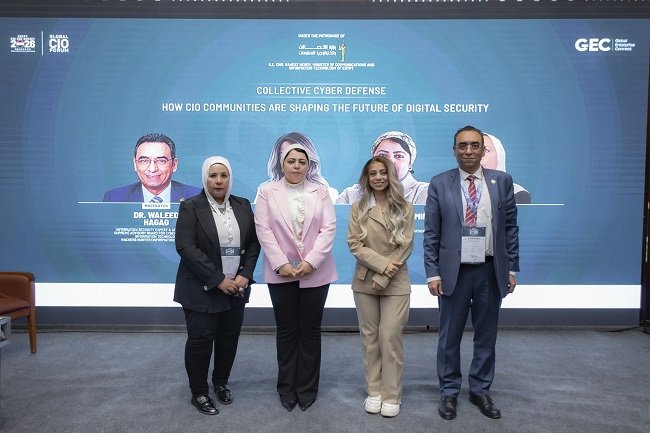
One of the summit’s most prominent discussions was the session titled “Collective Cyber Defense: How CIO Communities Are Shaping the Future of Digital Security.”
The session was moderated by Engineer Walid Haggag, cybersecurity expert, advisor to the Higher Authority for Information Technology and Cybersecurity, and widely recognized in Arab media as “The Hacker Hunter.”
The discussion challenged a long-standing assumption in cybersecurity: that every organization can defend itself independently.
Instead, participants examined a collaborative model based on trusted cooperation, structured threat-intelligence sharing, coordinated incident response and operational partnerships designed to identify and contain cyber threats before they spread across interconnected organizations.

From a Cinematic Scenario to a Practical Security Model
The screening of “Operation Trust Mirror” became more than an opening presentation. It established the conceptual framework for the collective cybersecurity discussion.
The film demonstrated how an AI-generated identity could initiate a chain reaction across interconnected organizations by exploiting trusted relationships between companies, business partners and digital ecosystems.
The message was particularly relevant to the current cybersecurity environment: attacks rarely remain limited to a single organization when businesses and digital platforms are deeply interconnected.
This reality makes collaboration a practical security requirement rather than an optional strategy.
The discussion therefore moved toward a broader question: How can organizations transition from isolated cyber defense to a collective cyber defense model capable of protecting entire digital ecosystems?
Cyber Threats Are Targeting Trust and Human Behavior
Participants highlighted that modern cyber threats extend far beyond conventional software vulnerabilities.
Attackers increasingly rely on identity compromise, social engineering, AI-generated deception, deepfake technologies, supply-chain attacks and the exploitation of trusted relationships.
These techniques can bypass conventional security controls by targeting people, identities and relationships rather than technical weaknesses alone.
Even organizations with mature cybersecurity programs can remain exposed if they operate without reliable mechanisms for exchanging threat intelligence and coordinating incident response.
Under the collective cyber defense approach, organizations become part of a broader security ecosystem capable of detecting threats earlier and coordinating defensive responses more effectively.
Cross-Sector Leaders Highlight the Shared Nature of Cyber Risk
The session brought together representatives from different industries, reinforcing the idea that cybersecurity challenges are not limited to one sector.
Participants included Dr. Ema Al-Bashawish, Founder of Smart Solutions and International Executive Candidate at The Gold Room Agency; Heba Samir Rizk, Director of Digital Transformation at AMOC; and Mona Mohamed Ibrahim Mourad, Head of Educational Technology at Futures Educational Systems.
The diversity of perspectives demonstrated how cyber resilience affects industrial organizations, government institutions, service providers and educational organizations alike.
The participants agreed that cybersecurity has become a shared executive responsibility across sectors.
Digital Identity Emerges as a New Cybersecurity Battleground
Digital identity was one of the strongest themes of the session.
Participants noted that artificial intelligence has transformed identity-based attacks, allowing malicious actors to move beyond traditional password theft and account compromise.
Attackers can now create convincing digital identities, fabricate executive communications, generate synthetic voices, manipulate video through deepfake technologies and produce highly convincing fraudulent documents.
This development has transformed identity security from a purely technical concern into a core business risk.
Organizations were encouraged to strengthen identity governance through continuous identity verification, multi-factor authentication, regular privilege reviews, the Principle of Least Privilege, immediate removal of unnecessary access rights and stronger controls over third-party and privileged accounts.
Artificial Intelligence Can Defend—and Attack
Artificial intelligence occupied a central position in the cybersecurity discussions.
Speakers highlighted AI’s ability to analyze huge volumes of security events, detect abnormal behavior, automate threat detection and accelerate incident response.
At the same time, cybercriminals are using similar capabilities to automate phishing campaigns, develop adaptive malware, create more convincing social engineering attacks and produce synthetic media designed to deceive individuals and security systems.
The challenge, therefore, is no longer whether organizations should adopt AI. The greater challenge is establishing responsible AI governance supported by human oversight, transparent decision-making and continuous validation of AI-generated results.
Technology, participants emphasized, should enhance human judgment rather than replace it.
Education Becomes a Critical Part of Cyber Defense
Educational institutions also received considerable attention during the summit.
Schools, universities and digital learning platforms are increasingly attractive targets because of the sensitive information they manage and their growing reliance on online services.
Protecting educational institutions requires more than securing networks. It also involves protecting student identities, securing learning platforms, classifying sensitive information, strengthening access controls and improving cybersecurity awareness among students, educators, administrators and parents.
At the same time, educational institutions were identified as essential contributors to building the future cybersecurity workforce.
Participants encouraged stronger cooperation between academia, government and industry through cybersecurity laboratories, student competitions, professional training programs and talent-development initiatives.
People Remain the First Line of Cybersecurity
Despite rapid technological progress, participants repeatedly stressed that people remain one of the most important factors in cybersecurity.
Many security incidents continue to originate from seemingly simple mistakes, including responding to phishing emails, sharing sensitive information without verification, excessive user privileges, insufficient security awareness and delayed incident reporting.
For this reason, organizations were encouraged to move beyond annual awareness campaigns and establish continuous cybersecurity education within everyday business operations.
Recommended approaches included regular micro-training sessions, simulated phishing exercises, practical scenario-based education, executive crisis simulations and continuous behavioral measurement.
Participants also stressed the importance of creating a culture in which employees can report mistakes and suspicious activities quickly without fear of blame.
Early reporting can often determine whether an incident remains manageable or develops into a major organizational crisis.
Trust, Coordination and Evidence Define Future Cyber Resilience
As the session approached its conclusion, three principles emerged as the foundation for future collective cyber defense: Trust, Coordination and Evidence.
Trust enables organizations to exchange sensitive cyber intelligence with confidence.
Coordination supports rapid and unified decision-making during incidents, helping reduce response times and limit operational disruption.
Evidence allows organizations to understand what happened, identify root causes, improve security controls and strengthen future resilience.
Together, these principles form a continuous operational cycle rather than three isolated stages of cybersecurity.
Engineer Walid Haggag emphasized that the future of cybersecurity will depend not only on the capabilities of individual organizations but also on professional communities capable of transforming trust into structured operational cooperation through governance, intelligence sharing and coordinated action.
30 Recommendations Set a Roadmap for Collective Cyber Defense
The session concluded with a comprehensive framework of 30 strategic and operational recommendations aimed at helping organizations transition from isolated cybersecurity practices toward coordinated cyber resilience.
The recommendations were based on the practical experiences shared by industry leaders and focused on integrating cybersecurity into enterprise strategy, strengthening operational resilience, improving cooperation and preparing organizations for an increasingly complex threat environment.
Security Must Be Built Into Digital Transformation
A major recommendation was that cybersecurity should no longer be added after digital systems are developed.
Instead, security should be incorporated from the earliest stages of planning and design through the Security by Design principle.
Organizations were encouraged to conduct cybersecurity risk assessments before launching digital platforms, online services or enterprise systems.
Digital transformation should also be evaluated according to an organization’s ability to protect critical information, maintain business continuity, detect incidents rapidly, respond effectively and recover with minimal disruption.
The report’s conclusion was direct: meaningful digital transformation cannot succeed without cyber resilience.
Cyber Risk Must Reach the Boardroom
The recommendations also call for a change in the way cybersecurity risks are communicated to senior executives.
Rather than relying primarily on technical terminology, cybersecurity professionals should explain cyber risks through their potential impact on business continuity, financial performance, corporate reputation, customer trust, regulatory compliance and strategic objectives.
Cyber resilience should therefore become an enterprise-wide responsibility involving executive leadership, legal teams, communications, human resources, operations and technology departments.
The report also recommends executive cyber crisis simulations to clarify responsibilities, escalation procedures, decision-making and crisis communications before major incidents occur.
Building an Operational Cybersecurity Ecosystem
Another major recommendation is that simply exchanging threat information is no longer enough.
Organizations should establish trusted operational communities capable of coordinating defensive actions in real time.
Such communities should have clear governance frameworks defining what information can be shared, who is authorized to share it, confidentiality requirements, validation procedures, incident reporting mechanisms and coordinated response protocols.
The recommendations also encourage secure communication channels between trusted organizations to address identity fraud, AI-enabled deception, deepfake attacks and large-scale impersonation campaigns.
Policymakers were further encouraged to explore regulatory frameworks that enable responsible threat-intelligence sharing while protecting privacy, commercial confidentiality and data-protection obligations.
Identity and Access Management Becomes a Strategic Priority
With digital identity increasingly viewed as a primary attack surface, the report places Identity and Access Management (IAM) among the highest organizational priorities.
Key measures include applying the Principle of Least Privilege, conducting regular privilege reviews, removing unnecessary access rights, strengthening third-party access governance, monitoring privileged accounts and implementing robust identity verification.
The recommendations also address the growing connection between Information Technology (IT) and Operational Technology (OT), calling for network segmentation, secure architecture, continuous monitoring and controlled connectivity.
As operational environments become increasingly interconnected, organizations must prevent cyber threats from moving laterally between corporate systems and industrial infrastructure.
Continuous Cybersecurity Training Is Essential
The report reiterates that people remain both an organization’s strongest security asset and one of its most frequently exploited vulnerabilities.
Cybersecurity awareness should therefore evolve from an annual compliance requirement into a continuous organizational capability.
The recommendations include frequent awareness campaigns, short practical learning sessions, simulated phishing exercises, scenario-based training and behavioral performance measurement.
Organizations should also encourage employees to report incidents early without fear of blame.
Training effectiveness should ultimately be assessed through measurable behavioral improvements rather than attendance numbers alone.
Protecting Educational Institutions Is a National Priority
The report calls for a unified cybersecurity baseline for educational institutions covering encryption, multi-factor authentication, identity management, backup and recovery, vulnerability management, penetration testing and incident reporting.
It also recommends collective cyber defense networks among educational institutions to facilitate the rapid exchange of threat intelligence, phishing alerts, compromised-account notifications and vulnerability information.
Students, teachers, administrators and parents should participate in cybersecurity awareness programs tailored to different age groups.
Educational institutions are also encouraged to contribute to the development of future cybersecurity professionals through laboratories, competitions, internships, academic partnerships and cooperation with government and industry.
Digital Forensics Turns Cyber Incidents Into Lessons
Digital forensics was another major component of the recommendations.
Participants stressed that effective incident response requires not only identifying attacks but also preserving legally admissible digital evidence.
Organizations were encouraged to establish standardized procedures for collecting, preserving, analyzing and documenting evidence from computers, mobile devices, servers, cloud environments, network logs, email systems and enterprise applications.
Maintaining an unbroken Chain of Custody throughout evidence handling was identified as essential.
The recommendations also call for forensic imaging and cryptographic hash verification to preserve evidence integrity during legal and regulatory investigations.
Importantly, forensic investigations should not end once attackers are identified. Their findings should be used to improve security controls, policies, risk management, incident-response plans and organizational learning.
Building a Shared Digital Future
The report concludes that eliminating every cyberattack is unrealistic in today’s rapidly changing threat environment.
Instead, organizations should focus on becoming resilient enough to detect attacks early, respond quickly, minimize operational disruption, preserve critical evidence, maintain business continuity, recover efficiently and continuously learn from incidents.
Achieving these objectives requires a move away from isolated security programs toward a collaborative operational model built on trust, governance, shared responsibility and sustained cooperation.
Cairo Delivers a Clear Message on the Future of Cybersecurity
The World CIO 200 Summit – Egypt Edition 2026 demonstrated that cybersecurity has evolved beyond a purely technical discipline.
It now intersects with business strategy, economic development, education, public services, industrial innovation and national resilience.
The Collective Cyber Defense session was among the summit’s defining moments, reframing the central cybersecurity question from “How do we protect our own organizations?” to a broader challenge: “How do we protect our shared digital ecosystem?”
“Operation Trust Mirror” captured that transformation by illustrating a world in which identities can be fabricated, trust can be manipulated and artificial intelligence can accelerate deception at unprecedented speed.
The summit ultimately delivered a clear message to technology leaders: the next generation of cyber resilience will not be built by organizations operating alone. It will depend on interconnected communities capable of turning trust into coordinated operational capability through collaboration, preparedness, intelligence sharing and shared responsibility.
Sign up for our mailing list to receive the latest news.