 التكنولوجيا وأخبارها بوابة مصر لأخبار تكنولوجيا المعلومات والإتصالات وفي أفريقيا كما تعتبر مصدر رئيسي للمعلومات حول تكنولوجيا المعلومات والاتصالات والفرص الاستثمارية المرتبطة بالاقتصاد الرقمي في المنطقة بالكامل



Huawei has unveiled a new vision for the Intelligent World 2035, introducing 10 key directions aimed at addressing the technological and infrastructure challenges emerging in the era of agentic artificial intelligence.
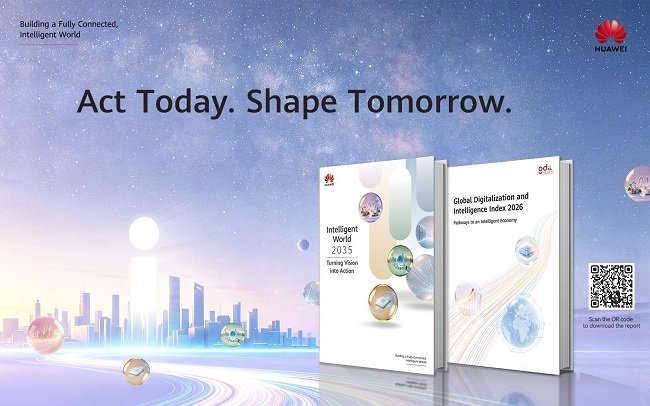
During an online launch event themed “Act Today. Shape Tomorrow,” Huawei officially released two major research reports: Intelligent World 2035: Turning Vision into Action and the Global Digitalization and Intelligence Index 2026.
Building on the trend landscape presented in 2024 and the 10 megatrends identified in 2025, the new Intelligent World 2035 report for the first time sets out 10 key directions for building an intelligent world. The report examines the major challenges created by the rise of agentic AI and proposes an actionable roadmap for the technology industry.
AI Moves From Digital Tools to Core Industrial Processes
Huawei’s report highlights a major shift in the role of artificial intelligence as AI expands beyond the digital environment and increasingly enters the physical world.
Rather than remaining a standalone tool, AI is becoming embedded in the core processes of business operations and society. This transformation is changing the underlying logic of industries while accelerating digital and intelligent transformation across multiple sectors.
David Wang, Deputy Chairman of the Board and Rotating Chairman of Huawei, described agentic AI as a key variable in this transformation.
According to Wang, reshaping operational models, competitive foundations and industrial dynamics requires the industry to address several fundamental challenges. He said the direction of change is clear, but turning the vision into reality requires concrete action.
This approach forms the central theme of Intelligent World 2035: Turning Vision into Action, which examines the pivotal changes created by the current AI revolution, analyzes the challenges behind them and proposes practical recommendations for an agent-centric world.
Agentic AI Creates an Agent-Centric Digital World
The report identifies agentic AI as a major force behind the transition from an application-centric digital world to an agent-centric one.
In this emerging environment, AI agents continuously perceive their surroundings, reason and make decisions autonomously, dynamically invoke tools and interact with humans in real time.
Each of these processes generates and moves large volumes of tokens, creating new demands on the technological infrastructure supporting AI systems.
Huawei forecasts that global annual token consumption could increase 100,000-fold by 2035, while traffic generated by agents could account for more than 90% of total traffic.
Such a transformation would place unprecedented demands on computing, networking and cloud infrastructure, going significantly beyond the requirements of traditional Internet applications.
Against this backdrop, Huawei has identified 10 key directions for the development of the Intelligent World.
Building AGI With Autonomous Cognition and General Capabilities
The first direction focuses on developing artificial general intelligence with autonomous cognitive and general-purpose capabilities.
Huawei identifies the move into the physical world as an essential path toward AGI. Achieving this objective will require continued advances in language intelligence, embodied intelligence and scientific intelligence.
Scaling Computing While Cutting Agent Costs
The second direction calls for computing clusters to scale by 100 times, while reducing the cost of agent tasks by 1,000 times.
Beyond increasing computing capabilities at the chip level, Huawei points to the need for a transition toward SuperPoD computing systems designed to deliver greater token output efficiency.
Developing New Storage and Memory Systems
The third direction addresses the evolution of storage and memory technologies.
Huawei highlights the need for novel systems capable of providing causal accuracy and trustworthy traceability, supporting the transition from basic data processing toward increasingly sophisticated forms of knowledge and memory.
Creating Experience-Centric Intelligent Connectivity
The fourth direction focuses on intelligent connectivity infrastructure centered on user experience.
This approach calls for AI to become more deeply integrated into communications systems, creating connectivity infrastructure capable of supporting the increasingly dynamic requirements of intelligent applications and agents.
Introducing the Tau Scaling Law
The fifth direction, known as the Tau Scaling Law, explores new methodologies for semiconductor design and development.
The proposed approach seeks to co-optimize latency and energy efficiency by replacing traditional geometric scaling with time scaling. Huawei sees this as a potential pathway for advancing chip design methodologies and tools while supporting the continued evolution of semiconductors.
Building an Agent OS for Autonomous Evolution
The sixth direction introduces the concept of an Agent OS, aimed at establishing an agent-native technological foundation.
Rather than simply enabling agents to harness their environment, the proposed architecture focuses on autonomous evolution. Huawei summarizes its capabilities through the formula:
(Coordination × Execution × Memory × Connectivity) ^ Evolution
The approach is intended to provide a technical foundation for increasingly autonomous and capable AI agents.
Making Device Intelligence Seamless and Adaptive
The seventh direction focuses on a new paradigm for device intelligence that is adaptive, seamless and available across different environments.
Huawei proposes intelligent capabilities that can operate ubiquitously across devices and scenarios, supporting the delivery of pervasive intelligent services rather than limiting intelligence to individual products or platforms.
Advancing Self-Learning and Safer Intelligent Driving
The eighth direction addresses intelligent driving, with an emphasis on self-learning and the highest levels of safety.
The objective is to enable vehicles to evolve beyond conventional transportation functions and become mobile embodied agents capable of operating within increasingly intelligent environments.
Overcoming Power and Thermal Constraints
The ninth direction tackles one of the fundamental infrastructure challenges facing the expansion of AI: energy and thermal limitations.
Huawei highlights the need to break existing power and thermal constraints in order to support continued growth in computing power across AI data centers.
Strengthening Security and Privacy for Intelligent Agents
The tenth direction focuses on safeguarding the Intelligent World through stronger security and privacy protections.
As autonomous agents become more capable of interacting with systems, tools and people, protecting data, interactions and agent operations becomes an essential component of intelligent infrastructure.
Building End-to-End Infrastructure Around Tokens
Huawei’s report argues that addressing the challenges of the agentic AI era requires the development of token-centric, end-to-end intelligent infrastructure.
Such infrastructure must cover the complete token lifecycle, including generation, delivery, consumption and security.
Huawei identifies several priorities within this model. These include building SuperPoDs and open ecosystems to improve token production efficiency, developing intelligent connectivity infrastructure to enable seamless token flows, and deploying agentic-native cloud platforms to accelerate AI adoption across industries.
The ultimate objective is to transform tokens into perceivable intelligent services that can reshape both personal user experiences and enterprise operational models.
Five Initiatives to Turn Innovation Into Progress
To support the transition toward the Intelligent World 2035, Huawei concludes its report with five strategic initiatives.
These include taking a long-term approach, remaining people-centric, upholding the principle of technology for good, maintaining a commitment to openness and collaboration, and adopting a systems approach.
Together, these principles are intended to help translate technological innovation into tangible progress across industries.
Global Digitalization and Intelligence Index 2026
Huawei also unveiled the Global Digitalization and Intelligence Index 2026, jointly developed with the Institute of Economics at Tsinghua University.
The report brings together perspectives from experts in economics, sociology and information and communications technology to examine pathways toward an intelligent economy.
According to the report, artificial intelligence is expected to generate more than US$27 trillion in cumulative economic value over the next five years.
At the same time, global investment in digital and intelligent infrastructure is projected to grow at a compound annual growth rate of 19.14%, exceeding US$4 trillion by 2030.
These investments are expected to provide a foundation for the continued expansion of the intelligent economy.
Data, Talent and Technology Form the New Production Base
The report also reframes the core factors of production in the digital and intelligent era around three elements: data, ICT talent, and digital and intelligent technologies.
Huawei emphasizes that the integration of networking, computing and storage creates the technological foundation required for successful industrial upgrading.
This convergence is positioned as an essential component of the infrastructure needed to support the next phase of digitalization and intelligent transformation.
90 Countries Assessed Across Three Development Stages
The Global Digitalization and Intelligence Index 2026 assesses the digital and intelligent development of 90 countries, grouping their progress into three stages: Builder, Adopter and Frontrunner.
The classification is intended to provide policymakers with clearer pathways toward developing an intelligent economy while recognizing differences in national conditions and development priorities.
The report stresses that there is no single universal model for the intelligent era. Instead, quantitative assessment can help individual countries identify their areas of focus and establish customized development pathways based on their specific circumstances.
Huawei Calls for Action Toward 2035
In the foreword to Intelligent World 2035: Turning Vision into Action, David Wang emphasizes the importance of translating long-term visions into practical steps.
He concludes that Huawei is prepared to work with customers and partners worldwide, with the objective of turning actions taken today into meaningful progress toward the Intelligent World 2035.
Sign up for our mailing list to receive the latest news.